What to Do When You Fall Sick in South Korea As a Foreign Traveler
Quick Summary
- What to do if sick while traveling in Korea: Don’t panic. Minor symptoms can be managed at local neighborhood clinics (ui-won) and independent pharmacies (yak-guk), while convenience stores stock basic 24/7 over-the-counter essentials.
- How to go to hospital in Korea as a tourist: Skip outdated travel guides telling you to dial the old Korea emergency medical service 1339 hotline. For immediate crises, dial 119 directly, and use the E-Gen app to pinpoint English-friendly night and holiday clinics.
- Insurance & Communication Tip: Always request English-language itemized receipts and a formal medical certificate before paying your bill, and dial 1330 for round-the-clock multilingual translation help.
Quick Navigation
- 1. Why 1339 is Outdated: The Shift to 119
- 2. Bridging the Language Gap: 1330 vs. 119 Translation Support
- 3. Navigating Local Pharmacies (Yak-guk) and OTC Limits
- 4. Finding Night & Holiday Care: E-Gen and Emergency Medical Information App
- 5. Managing Expectations at Major Hospital Emergency Rooms
- 6. Securing Mandatory Paperwork for Travel Insurance Claims
- 7. Utilizing the Overseas Korean & Traveler Emergency Medical Consultation Service
💡 Tip: Save important helpline numbers like 1330 and download the E-Gen mobile app before your trip starts.
⚠️ Common Mistake: Trying to dial the outdated 1339 hotline or arguing with ER staff to get faster service.
✅ Do This Instead: Visit local neighborhood clinics for mild symptoms and dial 119 immediately for true life-threatening emergencies.
Navigating a foreign healthcare system when a sudden fever or severe stomachache hits is nobody’s idea of a fun vacation. When you are standing on a busy Seoul sidewalk clutching your side, the last thing you need is conflicting or outdated administrative advice. Here is the unvarnished reality of how the local medical infrastructure actually works, and how to handle it smoothly without losing your sanity or your money.
1. Why 1339 is Outdated: The Shift to 119
Plenty of old travel forums and out-of-print guidebooks still instruct foreign visitors to dial 1339 for medical guidance and hospital referrals. Honestly, following that advice today will just waste precious minutes. That standalone hotline has long since been integrated into the national fire and emergency network under the Ministry of Health and Welfare.
Trying to call 1339 during an urgent situation usually leads to dead ends or frustrating redirection. For true medical emergencies or immediate hospital routing, skip the mental clutter and dial 119 directly.
2. Bridging the Language Gap: 1330 vs. 119 Translation Support
Even if your attending doctor speaks decent conversational English, the bureaucratic side of things—triage paperwork, liability waivers, and granular descriptions of sharp internal pains—can easily get lost in translation. Relying solely on broken English in a high-stress emergency room often paves the way for dangerous misunderstandings.
Keep 1330 (the Korea Travel Helpline) saved in your phone contacts. It provides 24/7 multilingual assistance in English, Chinese, and Japanese, which is immensely helpful for pre-hospital guidance or calling ahead to check if a clinic can handle a specific foreign patient. If you are already dialing 119 for an ambulance, the dispatchers can patch in a real-time three-way interpreting service on the spot.
3. Navigating Local Pharmacies (Yak-guk) and OTC Limits
If you are used to walking into a massive pharmacy abroad and grabbing industrial-strength pain relievers off the shelf, the local drugstores (yak-guk) might surprise you. South Korea maintains a relatively conservative policy on over-the-counter medications. Strong anti-inflammatories, certain migraine relievers, and specific prescription-strength cold formulas require a doctor’s sign-off.
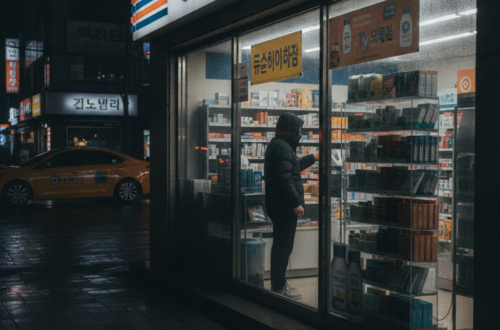
The common mistake is storming into a pharmacy demanding a specific foreign brand name, only to watch the pharmacist shake their head. For very minor travel ailments like mild headaches or jet-lag sluggishness, basic safety-certified painkillers and digestives are available 24/7 at convenience stores like GS25 or CU. For anything more stubborn, save yourself the guesswork: walk into a neighborhood clinic (ui-won) for a quick five-minute consultation and get a proper prescription.
4. Finding Night & Holiday Care: E-Gen and Emergency Medical Information App
Standard clinics and pharmacies across South Korea usually lock their doors by 7:00 PM on weekdays and operate on heavily shortened hours—or close entirely—on weekends and national holidays. Wandering the chilly or humid streets blindly looking for an illuminated green pharmacy cross late at night is a miserable experience.
Instead, pull up the Ministry of Health and Welfare’s Emergency Medical Portal (E-Gen) website or download the companion mobile app (Emergency Medical Information). It gives you a real-time layout of nearby pediatric night-care centers (Dalbit Children’s Hospitals) and holiday-duty pharmacies currently keeping their lights on. If data is an issue, dialing the local administrative help line (like 120 in Seoul) will get you a live operator who can read off nearby operating hours.
5. Managing Expectations at Major Hospital Emergency Rooms
Major university hospital emergency rooms in cities like Seoul or Busan are world-class institutions filled with cutting-edge equipment. However, treating non-emergency patients—think mild fevers, minor sprains, or general stomach discomfort—will result in crushing wait times stretching anywhere from three to six hours.
Foreign travelers often make the mistake of demanding expedited service at the front desk, assuming that offering to pay out-of-pocket cash will push them to the front of the line. Korea’s medical triage system (KTAS) ranks patients strictly by physical urgency, not by nationality or wallet size. If your symptoms are mild during daytime hours, visit a local neighborhood clinic. If it’s the middle of the night, look for a designated regional emergency medical facility rather than a crowded university center.
6. Securing Mandatory Paperwork for Travel Insurance Claims
Without national health insurance coverage, foreign short-term travelers must pay 100% out-of-pocket for medical fees, doctor consultations, and prescription drugs. The financial sting is real, but the bigger headache usually happens later when travelers try to claim reimbursement from their overseas insurance provider only to have it rejected due to paperwork technicalities.
Never leave the hospital registration desk or pharmacy counter with just a standard credit-card payment slip. You must explicitly request an English Detailed Medical Bill and an official English Medical Certificate (or an outpatient treatment confirmation). Some larger hospitals charge a small administrative fee for these English documents, but skipping them means eating the entire medical bill yourself.
7. Utilizing the Overseas Korean & Traveler Emergency Medical Consultation Service
Managed jointly by the National Fire Agency and the National Medical Center, this secondary resource provides remote medical advice for travelers grappling with unfamiliar administrative systems.
You can reach out via +82-44-203-3555 during standard weekday business hours for general procedural advice. Just remember what this service is *not*: do not waste valuable time calling an administrative advice line when you need physical, on-the-ground rescue. Life-threatening situations always demand an immediate, direct call to 119.
| Feature | Best Contact Number / Tool | What to Keep in Mind |
|---|---|---|
| Life-Threatening Emergency | 119 (Direct Dial) | Integrated with emergency medical dispatch; request 3-way translation if needed. |
| Multilingual Travel Help | 1330 (Korea Travel Helpline) | Available 24/7 in English, Chinese, and Japanese for pre-hospital guidance. |
| Finding Open Pharmacies/Hospitals | E-Gen (App / Website) | Essential for locating night, weekend, and holiday-operating facilities. |
| Minor Ailments (Nighttime) | 24/7 Convenience Stores | Good for basic safety-certified OTC items (bandages, simple digestives, pain patches). |
| Insurance Reimbursement | Hospital Admin / Pharmacy Counter | Request English Detailed Medical Bill and Medical Certificate immediately upon payment. |
spoontogether에서 더 알아보기
구독을 신청하면 최신 게시물을 이메일로 받아볼 수 있습니다.


당신이 좋아할 만한
Mastering Haebangchon Cafes: The Ultimate Insider’s Guide to Seoul’s Best Hilltop Views

Bypass Incheon Airport Queues: The Ultimate Guide to Seoul Station City Airport Terminal